Every rating system converges on the same number. Open a map of any major city and the restaurants worth eating at are 4.5 stars, and so are the ones that are fine, and so is the tourist trap with a two hour queue. Once a place collects a few thousand reviews, the average stops telling you anything except that a lot of people went.
Saves work differently. Nobody saves a place to be fair to it. You save it because you saw something and thought, I want to go there. It is a small, private, high-intent act, and in aggregate it turns out to be a much better signal than a score out of five.
What Trending actually shows you
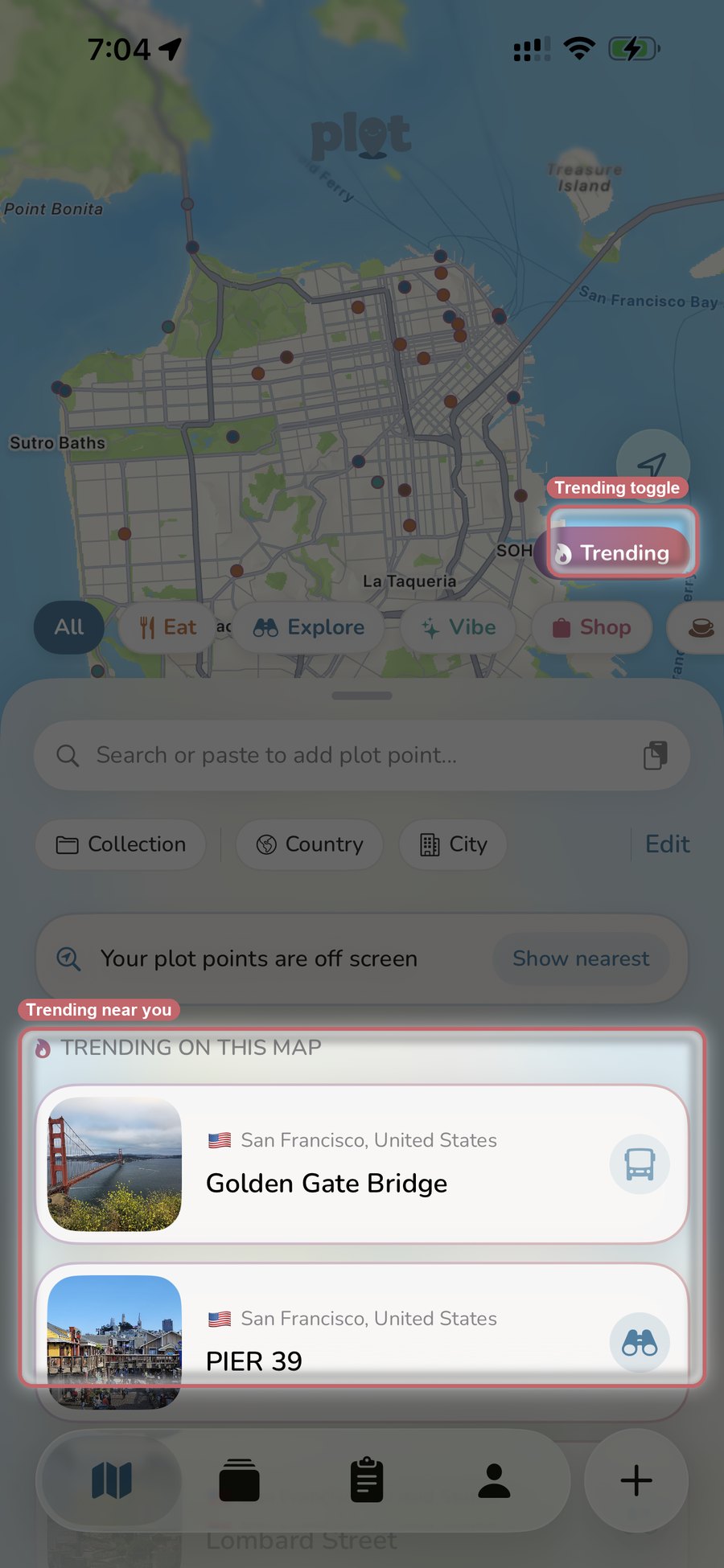
Flip on Trending and the map fills with places other Plotline travelers have been saving around wherever you are looking. Not the most reviewed places. Not sponsored ones. The spots people have been pulling out of TikToks and Reels and quietly adding to their own maps.
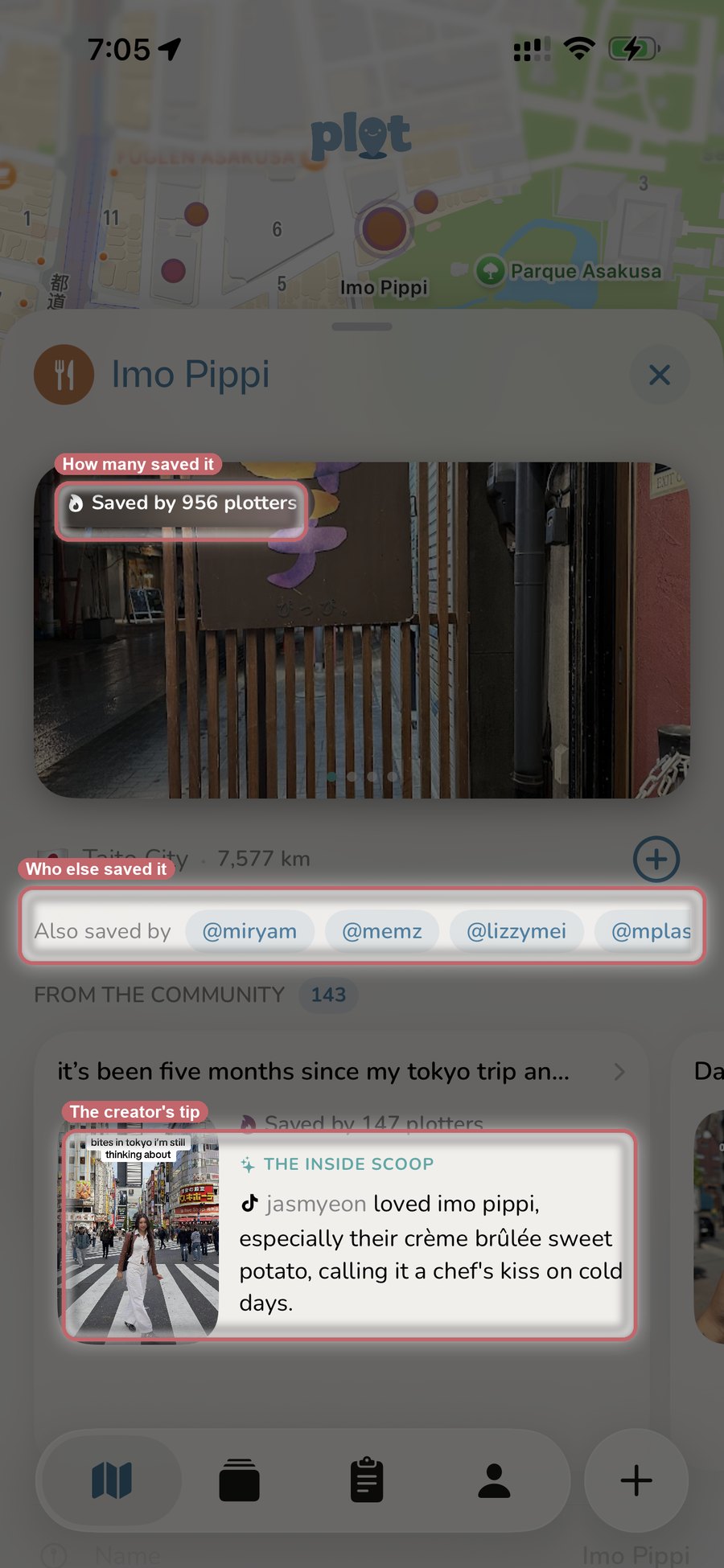
Each one tells you how many people saved it. That number is the whole point. A cafe saved by nine hundred people is telling you something a 4.6 rating cannot, because those nine hundred people were not asked to leave feedback. They just wanted to remember it.
The tip comes with it
This is where it stops being a popularity contest. Tap a trending place and you get the post it came from, and the specific thing somebody said about it.
Not "great food, will return." Something like a creator explaining that the sweet potato with the crème brûlée top is the thing to order on a cold day. That is the detail that makes a place worth a detour, and it is exactly what a star rating throws away.
How to actually use it
Three habits get the most out of it.
Scout before you go. Point the map at a city you are visiting and turn Trending on. You will get a feel for where the interesting clusters are, which is far more useful than a ranked list of the top ten attractions. Neighborhoods reveal themselves as dense patches of saves.
Use it when a plan falls through. The restaurant is closed on Mondays, it is raining, the museum queue is around the block. Open the map where you are standing and see what people have been saving within walking distance. This is the case ratings handle worst, because you are not trying to find the best thing in the city, you are trying to find something good near you in the next twenty minutes.
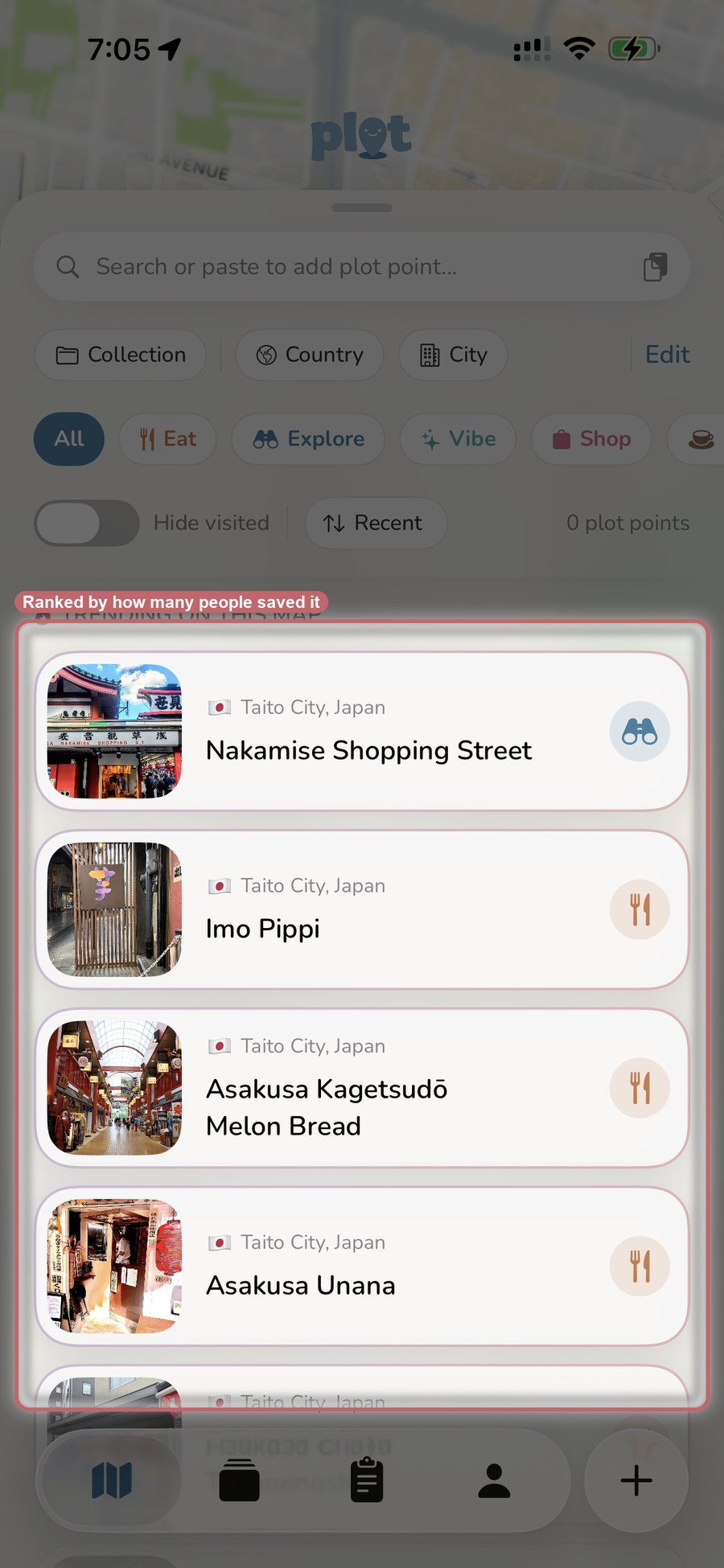
Browse the ranked list. If you would rather read than pan around a map, the same places appear as a list ordered by how many people saved them, so you can skim a city from the top down.
Why this works better than a review score
A review is written after the fact, usually by someone motivated by an unusually good or unusually bad experience. A save is a forward-looking bet, made by someone with no incentive to perform an opinion for strangers. That difference shows up in what surfaces.
Trending tends to pull up the bakery a food creator raved about, the viewpoint someone found at sunrise, the bar that is busy with locals on a Tuesday. It rarely pulls up the place with the biggest sign, because size is not what gets people to save things.
It also moves faster. Ratings take years to shift. Saves respond within weeks, so a place that just started getting attention shows up while it is still worth going, rather than after the queue has formed.
Where it pairs with your own map
Trending is most useful sitting next to the places you already saved. Your own pins are the things you specifically wanted. Trending is the ambient layer of what everyone else is finding, which fills the gaps your feed did not cover.
When you build a trip, both feed the same plan. Plotline sequences your saved places into a day-by-day itinerary with optimized routes and pulls in recommendations where you have not saved enough, so a discovery you made through Trending can end up as a stop on Thursday afternoon without you doing anything else with it.
The honest bit
Trending is a reflection of where Plotline travelers have been going. In dense, heavily travelled cities it is rich, and you will see hundreds of places. In a small town well off the usual routes it will be thin, because fewer people have saved anything there yet. That is the nature of a signal built from real saves rather than a scraped directory, and it gets better as more people plot.
Frequently asked questions
How do I find hidden gems when I travel?
Look at what people are saving rather than what they are rating. In Plotline, turn on the Trending layer and the map fills with places other travelers have been saving in that area, along with how many saved each one and the tip from the post it came from. It surfaces the spots people quietly bookmark, which are usually more interesting than the highest-reviewed places.
What is Plotline's Trending layer?
Trending shows what other Plotline travelers are saving right now wherever you point the map. Each place displays how many people have saved it and the original tip from the post it was pulled from, so you get context rather than just a score. The same places are also available as a ranked list.
Why are saves a better signal than star ratings?
Ratings converge. Once a place has a few thousand reviews, almost everything popular sits around the same score, so the number stops distinguishing anything. A save is made by someone with genuine intent to go, with no incentive to perform an opinion publicly, and saves respond to new places within weeks rather than years.
Does Trending work in any city?
It works anywhere Plotline travelers have been saving places, which covers 236 countries and territories and more than 26,000 cities so far. Dense, frequently visited cities show the most. Remote areas show less, and fill in as more people plot places there.
Can I turn a trending place into part of my trip?
Yes. Save it to your own map like any other place, and it becomes available when you build a trip. Plotline sequences your saved places into a day-by-day itinerary with optimized routes between stops.
Trending shipped in Plotline 1.2.3 on July 13, 2026. Related reading: what 40,000 travelers have actually been saving, how to plan a trip with friends, and the best apps for saving locations from TikTok and Instagram.